
Binary gender system is the overarching perspective on sex and gender. Sex and gender, in terms of the binary gender system, are stated as being socially and inherently interwoven to notions of masculinity and femininity. If you are male, then you must be masculine. If you are female, then you must be feminine. In response to this patriarchal perspective of sex and gender, the media has hyper-sexualized men and women with masculinity and femininity, respectively. By definition, men and masculinity, women and femininity, are synonymous with one another; thus, creating a dichotomy between the two. Within the binary gender system, there is only male and female; there is no in between. Embedded in this system is the heteronormative realm. If there is only male and female, masculine and feminine, then man is for woman and woman is for man. By creating this dichotomy and this binary, it invalidates all those that do not fit snugly into this hyper-masculine, hyper-feminine, heterosexual ideal.
The moment that a person is born, the socializing begins. There is always the prenatal question, “Is it a boy or girl?”, so one could also say that this socializing around gender can begin before birth. Following the clarification on the child's gender, the process begins by the appropriated colors of blue and pink. From here it is established that boys play with cars, GI Joes, or violent video games; girls play with dolls, play-kitchens, and read fairytales. According to Hubbard (1990), “This society, on the whole accepts Freud’s assumption that children are sexual beings from birth and that society channels their polymorphously perverse childhood sexuality into the accepted forms.” The key phrase is accepted forms. If a boy does not fit the socialized norm of masculinity, he is considered a sissy. Same with girls, if they do not meet the feminine ideal, they are considered a tomboy. There is a magnitude of socialized differences between the two genders, and a double-standard in terms of what is acceptable for boys is not for girls, and vice versa. For example, males become aware that their penis is a source of pleasure and procreation; whereas, females learn the function of sex and procreation, pleasure does not enter the frame until later (Hubbard 1990). This socialization creates the paradigm that men can indulge in sexual pleasure and women are responsible to give men this pleasure then produce offspring. Although procreation as the reason for sex does not hold the same way it has previously, women’s sexual desires and pleasures are still subordinate to that of men. This dynamic affects the way that men and women are socialized to interact with one another. Intermittently, the expectations for sex differs between males and females, "While sex is presented to women as something to be and something to do, for men it becomes somewhere to go and something to have" (Attwood 2005) in this sense, women are expected to perform sex and to do it, whereas men are required to achieve sex as if it were a trophy in a competition, or as if acquiring a material good.
The biggest influence on the binary gender system is the media in terms of establishing and perpetuating the ideals of femininity and masculinity. From here, the concept of agenda setting is derived, tying media to these expectations. Brown notes: “Agenda Setting/Framing Theories propose that the media tell people both what is important in the world around them, and how to think about the events and people who inhabit that world” (Brown 2002). This is to say that the images and stereotypes in media are constantly shown and reiterated. Women are shown as the “gatekeepers” of sex and men are shown as the sexual aggressors. “Topics and images that are frequent and prominent in the media become topics that audiences think are important” (Brown 2002). If audiences see these stereotypes as important, they begin or continue to emulate these ideas; which perpetuates the cycle of these notions. When the media portrays certain ideas, it gives the audience feedback as to what may be considered appropriate and inappropriate behavior. This parallels with the Cultivation Theory in that repetition of images, stereotypes, and ideologies reaffirms the binary gender system.
The media exhibits scripts for each gender to follow. “ …[Adrienne Rich outlines that] the Heterosexual Script entitles boys/men to prioritize their own sexual desire, to act on their sexual needs, to perceive their hormones to be 'out of control,' and to promise power and status to women in return for sex. …Thus, the Heterosexual Script compels girls/women to deny or devalue their own sexual desire, to seek to please boys/men, to ‘wish and wait’ to be chosen, and to trade their own sexuality as a commodity” (Kim 2007). As female sexual desire is denied, female sexuality has become commodified. For example, the notorious Rabbit vibrator has made sexual pleasure more safe, accessible, and mainstream. According to Attwood (2005), "... this moment is typical of a contemporary cultural trend towards representing women's sexual pleasure as fashionable, safe, aesthetically pleasing and feminine." The sex industry reconstructed the marketing strategy to appeal to wider consumer base through creating friendly and fashionable toys. Toys and accessories are now apart of the feminine realm. Attwood asserts, "It is striking that in this repackaging of sex across the range of brands, there is a very clear perception that sex must be made over as nice, bright, and accessible. This is achieved by clearly signifying sexual representations, products and practices as stylish, classy, and fashionable." By commodifying sex for women, it continues the consumption and commodification of gender. Being a women is to be hyper-feminine which requires beauty products, fashion, and the notion of "being made-up."
Media depicts men as hyper-masculine beings that are in the aggressive pursuit of sex. According to Brooks’ Centerfold Syndrome (1995), men are just as victimized by the media as women. In media images, a man’s masculinity is not only defined by his muscles but is also defined by his status and the objects and women around him. The Centerfold Syndrome consists of five factors: voyeurism, objectification, the need for validation, trophyism, and the fear of true intimacy (Brooks 1995). The Centerfold Syndrome acknowledges that women are objectified by men, but it also posits that men are required to fill the role of being the objectifiers. Through cultural expectations, this power dynamic explores further the socialized relationship between men and women. Brooks also notes that the idea of masculinity is vague therefore creating the need for men to constantly validate their masculinity. This notion can be seen in advertisements where men are positioned as power figures surrounded by material objects and/or objectified women. As women are objectified, men's bodies become invisible, invincible, and detachment machines. Moye notes that when it can be glimpsed, the male porn body is mechanized as a piece of equipment; there is an obsession with size, quantity, technique and drive” (Attwood 2005). The pleasure is only seen through the facial expression of the female; whereas the male remains invisible. The male must be validated through the female who is meanwhile being objectified by the male. The binary gender system continues to cycle through the media out into society only to perpetuate an insecure, unhealthy depiction of gender and sexuality for both men and women.
Wednesday, March 10, 2010

Tuesday, February 23, 2010
Sexualized Minorities, "Sexual Otherness" and Heterosexism in the Media
In the Acuvue commercial, it appears to be a commercial for contacts; however, it is used to show “lipstick” lesbians. The girls in the video are twins which makes the “lipstick” lesbianism in this video the more ridiculous. There is a scene where the camera zooms in on the sisters interlocked hands on one of their thighs. The scene is meant to satisfy the heterosexual male gaze. Also, in the video the interaction between the twins is sexual by the flirtatious touching. For example, when the sister approaches the other, she places her hand on her hip near her bottom.
t.A.T.u. is another example of “lipstick” lesbians. The video displays the two singers as intimate partners. They are shown wet in school girl outfits interacting with one another intimately. There is a fence that separates them and the crowd. They are segments leading up to their kiss. The camera angle changes indicate that their performance is for the crowd. They are shown subjectively indicating that their relationship is for the pleasure of their audience rather than themselves.
This third image is a one-time character that was shown in a Bones episode. In this episode, the character, Dr. Tanaka, is androgynous. The other characters spend the entire episode contemplating Dr.Tanaka’s gender. By the end of the episode, it is decided that the character is male because he had an erection when one of the female characters approached him. The gender paradigm in our society is binary and the desire to label a person as male or female is obsessive. This character never appears again which demonstrates the margins for sexuality and gender in media.
The Christina Aguilera music video “Beautiful” displays homosexual couple and a man in drag. The song is very powerful and validates their sexual “otherness”. There are several scenes where the young, white homosexual couple is displayed intimately in public holding hands and kissing intimately. There is another scene where the tongue in the kiss is shown and passerbys are looking down at the couple. The passerbys looking down at the couple are in a position of power and may be seen as representative of society’s view of LGBTQ relationships. The drag queen is shown in snippets as he dresses. He is first shown in his underwear, then puts on a bra, then makeup, next jewelry, the dress, wig, and lastly smiling in the mirror. The video also critiques ideals of masculinity and femininity. By the end of the video, everyone has rejected the ideas established by society and smiles at themselves despite their “otherness”.

t.A.T.u. is another example of “lipstick” lesbians. The video displays the two singers as intimate partners. They are shown wet in school girl outfits interacting with one another intimately. There is a fence that separates them and the crowd. They are segments leading up to their kiss. The camera angle changes indicate that their performance is for the crowd. They are shown subjectively indicating that their relationship is for the pleasure of their audience rather than themselves.
This third image is a one-time character that was shown in a Bones episode. In this episode, the character, Dr. Tanaka, is androgynous. The other characters spend the entire episode contemplating Dr.Tanaka’s gender. By the end of the episode, it is decided that the character is male because he had an erection when one of the female characters approached him. The gender paradigm in our society is binary and the desire to label a person as male or female is obsessive. This character never appears again which demonstrates the margins for sexuality and gender in media.
The Christina Aguilera music video “Beautiful” displays homosexual couple and a man in drag. The song is very powerful and validates their sexual “otherness”. There are several scenes where the young, white homosexual couple is displayed intimately in public holding hands and kissing intimately. There is another scene where the tongue in the kiss is shown and passerbys are looking down at the couple. The passerbys looking down at the couple are in a position of power and may be seen as representative of society’s view of LGBTQ relationships. The drag queen is shown in snippets as he dresses. He is first shown in his underwear, then puts on a bra, then makeup, next jewelry, the dress, wig, and lastly smiling in the mirror. The video also critiques ideals of masculinity and femininity. By the end of the video, everyone has rejected the ideas established by society and smiles at themselves despite their “otherness”.

Wednesday, February 17, 2010
Socially Constructed "Appropriate" Sex

KY Intense - Maximum Pleasure Commercial - More amazing video clips are a click away
All of these images portray heterosexual relationships whether as a couple or a sexual encounter. The first image, Calvin Klein Jeans advertisement, is in stark black and white displaying a wet and dirty female whose eyes are closed. From her facial expression, hand positioning, and body positioning, she is displayed as vulnerable and in the throws of passion; however, she has all her clothing on. The male is also wet and engaged. His expression is hungry. His position indicates his masculinity through aggression. He is on top and displayed above her. Clearly, he is in the power role. The gender roles are stereotypical. The male is the aggressor, completely masculine, always wanting sex, and in power. The female is passive, vulnerable, always willing to have sex, and subordinate to the male. Another detail to take into account is that both people are youthful.
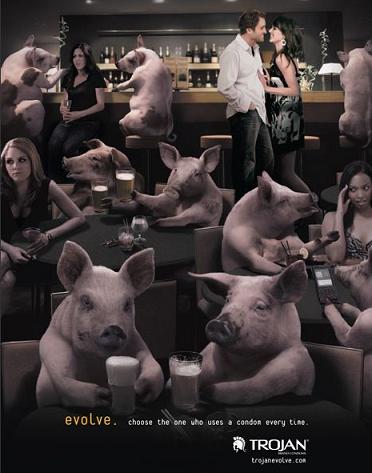
The second image is a Trojan advertisement. The advertisement makes a direct metaphor about men being pigs specifically that they are pigs unless they are wearing a Trojan condom. The background of the ad is a bar; the bar is packed full of pigs drinking beer. There are three single females surrounded by pigs and one female enthralled in intimate conversation with a man. In this advertisement, the woman is the aggressor. The male’s body position indicates a calm and collected persona. He is the alpha male and does not need to pursue; he simply has to accept the woman that engages him. His hand in his pocket indicates a laid back appeal. The woman’s body positioning is close, her hands are on his chest, she’s smiling, and there faces are close together. The positioning of the two of them indicates the intimacy and desire of the moment.
The last three artifacts are commercials. The first is a Dentyne Ice commercial. The princess finds her frog and once she kisses it, it turns into her prince. This is based off of the fairytale The Frog Prince. This once again displays the heterosexual relationship.
The second commercial is for KY intense. The commercial displays a heterosexual couple in bed. They discuss how they are having better sex with the KY intense. It never shows the couple engaging in intercourse but it does allude to the idea of the woman having an intense orgasm. After the scene indicating her intense orgasm, it shows the couple closer together, more intimate. This commercial alludes to the idea that sex is the only way to engage in intimacy.
The last commercial displays heterosexual couples on vacation. The couples are youthful or mature but not old. All these artifacts demonstrate that the socially constructed “appropriate” sex in our society must occur between heterosexual, young couples. They never “have sex”; the sex is assumed. It would be deemed inappropriate for the display of intercourse to be shown.
Tuesday, February 9, 2010
Masculinity




In Lil Wayne’s album cover, he is shirtless and his body language demonstrates a “hard” persona. He is wearing baggy jeans, has money in his pocket, and an escalade in the background. He needs the money, car, and jewelry to demonstrate his power, his status. His gaze is diverted from the camera and mouth is rigid. He is exemplifying the idea that men need the things around them to define their masculinity. The media presents this idea that masculinity is defined by one’s surroundings. The status symbol of power is exemplified by his “bling”, money in his pocket, and the expensive car behind him. That is all that is shown in the image and that is portrayed to be the makeup of a man.
On the Esquire cover with Obama, notice the camera angle. It is looking up, which portrays Obama as an aggressor, someone with status, and someone with power. He is dressed in a suit and appears to have a professional occupation. His arms are crossed showing a powerful reservation. He is peering off into the distance. When men are shown on the covers of magazines, they are rarely objectified or scantily dressed. Obama is professional, powerful; he is a man.
On the cover of Sports Illustrated, we have LeBron James. We are shown his profile with his eyes closed, dressed in his uniform. He appears deep in concentration, completely aware. In the back of his neck, you can see a vein throbbing and his jaw is tight. He has tattoos on both arms. He gives off the impression of a warrior preparing for battle. To the left of him the text reads in white font “The Power of” then in black font “LeBron”. The only lettering on the page in black font is his name. He is meant to stand out; he is an independent individual. This emphasizes that a man should be like a warrior, be masculine like a warrior preparing for battle.
In the Armani underwear ad, we have David Beckham. His muscles are tensed, his eyes narrowed, and his mouth rigid. His facial expression exerts anger and intensity. The tattoos on his arms emphasize his warrior position. Again, the eyes are turned away from the camera. The image is shown objectively even when the only clothing is underwear. Strength and aggression, again, are the illustrators of man.
Lastly, in the Chocolate Axe commercial, the man is surrounded by women. In all Axe ads, women are pining over men. Men’s alpha male ego is fed by the amount of women that desire them. Men are once again defined by their surroundings rather than defining themselves.
Tuesday, February 2, 2010
Femininity

I chose all of these artifacts for various reasons: the innocence, fragility, neediness, and the roles women play in tasks and relationships. The readings for the week had been: “Can Women Have Sex Like a Man?”: Sexual Scripts in Sex and the City, Pixel Pinups: Images of women in Video Games, and Two Steps Forward, One Step Back: The Selling of Charlie’s Angels and Alias. The first artifact is a Calvin Klein advertisement for their Euphoria fragrance; the second artifact is the Vampire Diaries trailer; the third artifact is the video game promotion for Dreamfall: the Longest Journey; the fourth artifact is the Valentine’s Day trailer; and the last artifact is the Yesterday music video with Toni Braxton and Trey Songz.
When examining the first artifact, one can see that the model is white, thin, and beautiful. She appears to be wearing a bed sheet and is holding an orchid. The name of the orchid flower is derived from the Greek word orchis, meaning testicle. Euphoria means a feeling of happiness, confidence, or well-being sometimes exaggerated in pathological states as mania. The image in this advertisement illustrates the woman as one in a state of euphoria holding onto the purple bedsheet while holding a flower named after the male testicle. In the Sex and the City article, it states, “Women’s fashion magazines proffer specifically feminine roles with the implicit assumption that women need and want instruction on the skills necessary to successfully perform these roles. They offer an exclusionary construction of feminine identity: young, white, beautiful, thin, and heterosexual.” This is what people constantly see being portrayed of women. The Calvin Klein ad is a perfect example.
The trailers for Vampire Diaries and Valentine’s Day also promote this idea. The main female roles displayed in these trailers are all “young, white, beautiful, thin, and heterosexual.” In the Vampire Diaries trailer, it also shows women to be weak in that they “need to be saved or protected.” The women portrayed in this trailer are quiet, afraid, and only speak when they are calling out for help or out of fear. The only other times they were vocalized was in their thoughts and when they were being flirtatious. In Valentine’s Day, the trailer displays women as these needy, provocative creatures that need to have a male counterpart to feel complete. The expression on Jessica Alba’s face when she has to correct her statement of “Room for two.” to “Room for one and a dog.” encapsulates this idea that women need to have a man in their life and to be single on Valentine’s Day is essentially wrong. “Television provides a cultural forum through which viewers can learn about their social selves. It can also be influential in identity construction.” This movie trailer dictates a heterosexual life that women are supposed to lead as well as connoting this dependency women should have with men.
In the third artifact, the game shows a variety of female characters. Although, one of the heroes is a woman, the character that needs to be saved is also a woman. It, also, displays a woman embraced with a child and again with a man. These embraces signify “motherly” affection and heterosexual intimacy, respectfully. There is also a moment where affection with a crow is displayed to allude to this connection and empathy with nature and animals. Women were also displayed as maids and receptionists.
The last artifact similar to the Valentine’s Day trailer exhibits women as in need of male affection. In the music video infidelity arose and she is quickly shown with a new male companion. This alludes to the need for women to constantly be in a heterosexual relationship with the desire for dependency rather than finding independence and solace in being alone.
Tuesday, January 26, 2010
Pornography In Mainstream Media


I chose each of these media artifacts for different reasons. In the first artifact, it has two women in the restroom. Jenny McCarthy is sitting on the toilet as Kelly Clarkson is in the bath tub. This is an advertisement for Candie's shoes; shoes, however, is not what they are selling. Jenny McCarthy is a woman of many talents and began her career as a Playboy model. This is an example of everyday porn in that it alludes to the male fantasy of two women. In examining the advertisement, one can see the gasp on Kelly Clarkson's face and the "whoops" on Jenny McCarthy's. What the cause of these facial expressions is un known but the placement of the women is precise. They are close in proximity and sexually vulnerable. Jenny McCarthy with her underwear down and Kelly Clarkson naked in a tub.
The second artifact is the scene in Aladdin where he is on the balcony and under his breath says "teenagers take off your clothes". This is an example of how pornography is tied into everyday media including children's movies. There are different articles that suggest this: Hidden Sexual Messages Found in Disney Movies (http://www.bgsu.edu/departments/tcom/faculty/ha/tcom103fall2003/gp13/gp13.pdf) and a video that explicitly shows the comment:
The third artifact are the urinals that are shaped as women's mouths. These urinals play out the fantasy of urinating on women, more specifically urinating in their mouths. It produces the violence and objectification that can be relayed back to a majority of pornography.
The next artifact is an advertisements for the Longchamp Legend Purse. In the top image, she is sexually positioned with her legs spread open dressed in lingerie. Advertisements are consistently used to portray sexually available women to continue the male fantasy of women that always want sex.
The last two artifacts are used to demonstrate the differences between the female advertisement and the male advertisement for the Shake Weight. In the female advertisement, although the women are clothed, there is a focus on their breasts and cleavage. In the male commercial, the men are shirtless. The machine itself imitates the up and down movements of the "hand job." In these workout videos, both men and women are cut into sections of the body. The primary focus of these advertisements is the body and emphasis is placed in the commercial on the value of image. For women, there is the promotion to be thinner and for men, there is the promotion of being "ripped".
As discussed in class and in the articles, porn is everywhere and camera angles, music, positioning, and lighting are just some of the ways that these everyday images replicate the same ideas as pornography.
Wednesday, January 20, 2010
Sexuality As A Social Critique

In the Nike campaign to replicate the idea of “real women” in advertising, it helps to reinforce the idea of women as they are rather than these thin, white, skinny women. The images of these women are in black and white and cast in shadows so as not to uncover the ethnicity or race of the women. Only part of the women is photographed so as to commodify her into pieces. Along with each image is a poem or brief monologue spoken by the body part displayed. This one in particular exhibits the woman’s butt. In the lines, it reclaims the “butt” as a body part that has attitude and power in its own sexual prowess. In a sense, it critiques the idea of sexuality in the acceptance of the body rather than be ashamed and desire to be thin.

Some bathrooms now exhibit the sign that there are baby-changing tables within the men’s restroom. Originally, only women’s restrooms would have the baby-changing tables. This sign critiques the male gender role. It acknowledges that men, too, can change diapers and care for children.

This advertisement is from the Dove campaign for “Real Beauty”. This particular ad focuses on age. The woman displayed has gray and white hair, wrinkles, and age spots to demonstrate her age. The woman is nude and her entire body is shown. The ad says, “too old to be in an anti-aging ad.”, across her breast. Underneath her image it says, “but this isn’t anti-age, this is pro-age.” The ad at first glance reemphasizes the fear of age and how old is not beautiful. The statement underneath the article critiques women’s sexuality as being infinite rather than female beauty lasting only in a woman’s “prime”.
The Vagina Monologues were created to raise awareness about sexual assault. This particular monologue empowers women’s sexuality to the extent of seeking orgasms. It critiques female sexuality as having the ability to be the aggressor and that women are capable of having sexualities outside of the passive stereotype.
This commercial advertisement from Dove demonstrates the use of airbrushing in advertisements and the image of impossible perfection that is being sold. It critiques female sexuality so as to say that, “We are all beautiful. No one really looks like those images in the media.”
Subscribe to:
Comments (Atom)